As Attila scourges the Roman empire and outmanoeuvers its forces, the emperor in Constantinople seeks a way to stop the ongoing ravages, and so a conspiracy is hatched to assassinate the Hunnic ruler.
In this episode, we follow a writer named Priscus who was part of a Roman embassy to Attila. Invited to dinner with the Hunnic ruler, Priscus entered the feast hall and saw Hunnic nobles wearing jewellery that reproduced Roman fashions, and Attila sitting on a lavish couch in the centre.
Priscus relates that, “when all were arranged, a cup-bearer came and handed Attila a wooden cup of wine. He took it, and saluted the first in precedence who … stood up and might not sit down until the king, having tasted or drained the wine, returned the cup to the attendant. All the guests then honoured Attila in the same way … but he did not stand up.”
When this ceremony ended, “a luxurious meal, served on silver plates, had been made ready for us and the barbarian guests, but Attila ate nothing but meat on a wooden trencher. In everything else, too, he showed himself temperate … His dress was quite simple, affecting only to be clean. The sword he carried at his side, the latchets of his Scythian shoes, the bridle of his horse were not adorned, like those of the other Scythians, with gold or gems or anything costly.”
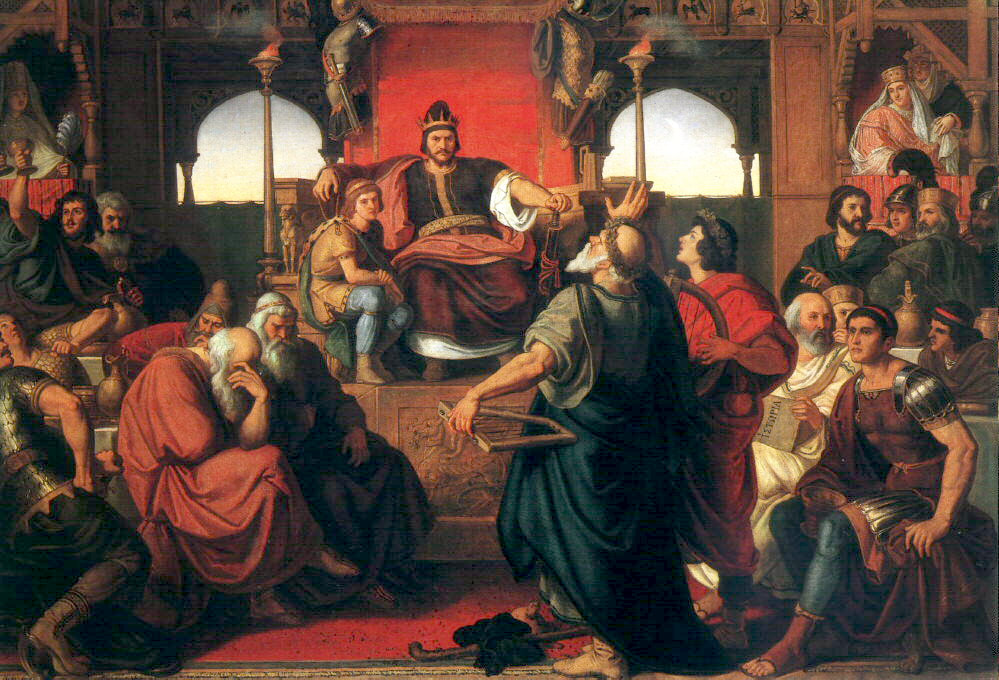
Feast of Attila by Mór Than, 1870
When evening fell, two bards sang of Attila’s “victories and deeds of valour in war.” Afterwards, a “Moorish dwarf” named Zerkon made an appearance. At this time, the word “Moor” referred to inhabitants of the Roman province of Mauritania in northwest Africa. We don’t know how Zerkon first came to Hunnic territory, but we know that Attila’s brother Bleda had patronised him and offered him a Hunnic wife.
Bleda had been murdered in a bloody civil war, and his supporters, including Zerkon, had been exiled. The Moor now journeyed back into Hunnic territory to find his wife, yet “he did not succeed in recovering her, for Attila was angry with him for returning. On the occasion of the banquet he made his appearance, and threw all except Attila into fits of unquenchable laughter by his appearance, his dress, his voice, and his words, which were a confused jumble of Latin, Hunnic, and Gothic.”
In fact, all through the evening, the only occasion on which Attila showed any emotion was at the approach of “Ernas, his youngest son, whom he pulled by the cheek, and gazed on with a calm look of satisfaction.” Priscus continues: “I was surprised that he made so much of this son, and neglected his other children, but a barbarian who sat beside me and knew Latin, bidding me not reveal what he told, gave me to understand that prophets had forewarned Attila that his race would fall, but would be restored by this boy.”
If you want the rest of the details, head here to read Priscus’ original retelling of his dinner with Attila.
Leave a Reply